Thursday, November 13, 2014

Entry Nineteen: Lee

"Coming Home Again"
Chang-rae Lee (1995)

"Sometimes I still think about what she said, about having made a mistake. I would gave left home for college, that was never a doubt, but those years  was away at boarding school grew more precious for her as her illness progressed. After many months of exhaustion and pain and the haze of the drugs, i thought that her mind was beginning to fade, for more and more it seemed that she was
seeing me again as her fifteen-year-old-boy, the one she had dropped off in New Hampshire on a cloudy September afternoon."


There’s a bittersweet feeling rippling through me as I write this, and I can’t figure our if it’s because this is the last chance I get to do a reflection for this class, or because this story is so fitting for an ending. There’s a very strong feeling of finality to this, and I can’t quite shake myself from it. It’s sobering and sad, but at the same time quite fascinating, and a feeling that I haven’t been made to experience in a while. Perhaps it’s something worth struggling through for now.

This story, on many levels, hit me very close to home; I felt an immediate connection to the narrator, because his experiences with his family were so very similar to mine. Cooking in his family was as integral as it was to my own – even though I’m speaking from an Italian background, not a Korean one. My mother was always in the kitchen, cooking something new for us; and I, much like the narrator, would linger around her feet as a child, looking up and trying to see what she was doing.

What really is communicated through this narrative is the briefness of life, and the importance of honesty as well as family. It’s emphasized through the relationship between the narrator and his mother – through his growing up and time at boarding school, their relationship is strained. It’s further tested through her sickness, and the terminality of their connection as mother and son. The impact of the realization the son has – that his mother is going to die, and he cannot stop it – makes him cherish the time left for them to share.

The importance of family is closely connected to the first theme – the narrator’s family is joined by the seriousness of the mother’s condition. The narrator’s father comes home early from work to spend time with his family, his sisters come home from their jobs out of the state to stay with their mother. It took a catastrophe for their family to come back together, and it’s a very realistic reaction from a family. But I think part of the author’s goal here is to show that time with your family is precious and valuable – you should take advantage of every moment, and spend as much time as you can with them.


You never really know when you’ll lose them.

Thursday, November 6, 2014

Entry Eighteen: Viramontes

"The Cariboo Cafe"
Helena María Viramontes

"But her legs are heavy and she crushes Geraldo against her, so tight, as if he wants to conceal him in her body again, return him to her belly... screaming, howling, sobbing, shriveling and crying because he is only five years old, and all she wanted was a mango. But the crying begins all over again. In the distance, she hears crying."

This is the fourth time I’m attempting to write this analysis. The issue isn’t with story and its contents, but more with myself. Even more so, I think that this story overwhelmed my senses in ways that usually physicality is only capable of. I find myself lost and confused, because this reading took my on an emotional adventure that I wasn’t sure I wanted to go on. Regardless, it was necessary, and I found myself very much heartbroken by the final page.

Something I found fascinating was how this story was written – the jumps and changes in narrator gave each passage a new perspective, and with that a new range of emotions to grapple with. In many instances, I found myself sick to my stomach, because the emotions were so raw and real and terrifying. These people were suffering through every day, forcing themselves to go that one step further because there wasn’t much else left. The use of multiple narrators was fascinating, but with it, I found myself very confused.

As far as I’m aware, the story is centered on one family – a mother and her two children, a daughter and a son. The confusion that came with this story, both with its choice of narration and content in general, communicated a very important theme throughout the story. This life of poverty is a challenging one, and for children who can’t speak a language enough to communicate, their world quickly becomes large and intimidating. This barrier was shown throughout the story, either in a physical or nonphysical way.

Regardless of such, this family fought through these barriers the best they could.

What gave me the most trouble, and by many regards has left me stunned and confused, was the last page or so. In it, the police is hunting these children, for reasons I’m still not entirely sure of. What I can’t quite understand is who gets shot at the end?  At first, it felt like his sister, who’d been struggling to keep her brother to her chest.


But with the last sentence, it felt like the words of a mother.
Perhaps, they’re one in the same?

Tuesday, November 4, 2014

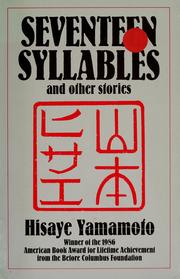
Entry Seventeen: Yamamoto

"Seventeen Syllables"
Hisaye Yamamoto (1988)

"It was like a story out of the magazines illustrated in sepia, which she had consumed so greedily for a period until the information had somehow reached her that those wretchedly unhappy
autobiographies, offered to her as the testimonials of living men and women, were largely inventions: her mother, at nineteen, had come to America and married her father as an alternative to suicide."


Unlike the majority of the stories we’ve read, this one took a much longer time to get used to and understand – I can’t decide if it’s how it’s written, or how the majority of the plot seems to happen in the last half of the story. There was a certain amount of time where I really wasn’t interested in the story at all, and it wasn’t until the last half or so that I was even interested. That being said, I saw a lot of this story as a coming of age story. It’s how Rosie was, in many respects, forced into adult life and adult problems within the span of these pages.

Something that caught my attention especially was the mindset of our third person narrator, Rosie. There was a part of her that was very young, but still mature for her age; after all, she’s working on her father’s tomato farm, so she has a certain amount of responsibility. But at the same time, there are moments where I feel like her expectations aren’t always in line with the maturity she displays. The biggest example of this is with her father; her relationship is strained with him as it is, so her openness and hope for something genuine is wonderful, but at the same time, lining her up for disappointment ever time.

Perhaps, the thing that stuck out to me the most was the consistent theme of time – there’s mention of deadlines for her mothers haiku’s, her fathers farm, her meeting with Jesus. There’s always something waiting to happen, something scheduled that looms overhead. This seems most evident when her mother admits her past to Rosie at the very end of the story – something so sensitive and personal was held off until the very last moment. In this case, time was misused, leading to an admission at probably one of the worst times.


It is, though, a reminder at how fragile our time is – how one day, everything you know can change.

Thursday, October 30, 2014

Entry Sixteen: Márquez

"The Handsomest Drowned Man In The World"
Gabriel García Márquez (1968)

"...they were going to paint their house fronts gay colors to make Esteban's memory eternal and they were going to break their backs digging for springs among the stones and planting flowers on the cliffs so that in the future years at dawn the passengers on great liners would awaken, suffocated by
the smell of gardens on the high seas... look there, where the wind is so peaceful now that it's gone to sleep beneath the beds, over there, where the sun's so bright that the sunflowers don't know which way to turn, yes, over there, that's Esteban's village."


When I saw the title of this story on the syllabus, I was, if nothing else, hopelessly confused. The mental image I have of a man who’s been drowned is nothing short of horrifying – and for an author to choose handsome, out of the plethora of other possible adjectives available, it definitely captured my interest. And after reading this short story twice, I’m equally enthralled, as I am confused.

Also, I’ve been inclined to actually use my relatively expansive vocabulary.
But that might not be directly influenced by this short story.

Anyway.

I did my best to focus on setting at the beginning, since that’s the main focus of our final unit. It was interesting to me that this entire interaction takes place with, really, a handful of people in a very isolated place. The population of this village very much plays into the small-town stereotype; they’re hesitant of things that are apparently new to them, or of strangers entering their lives. In the case of this drowned man, however, they are initially very unforgiving upon his arrival – children are playing with his corpse on the beach.

 When he’s laid out for the women to care for him, it’s when they first start to show him some kindness. They realize, once he’s cleaned and presentable, that this stranger is handsome – he’s built like a lumberjack, more or less, and is very much an enigma. What amazed me about this is how quickly these women changed, and how they are willing to adopt this “orphaned” man, taking care of him and very quickly loving him like a family would. It shows the kindness people are capable of, especially in someone’s last moments.

I very much see this story as a parable to people, of people – it shows that in the darkest of times, there is a time and place for good. The people of this village are given a very unhappy task, and at first they face it as such. But after further thought, the women remembering that this man was, in fact, a man – he had troubles like anyone else, a life and struggles and connections like everyone else.

This is why, I believe, they show him tenderness; they decorate his body, they put forth so much effort for this man’s burial. In the end, this town takes Esteban as their own and gives him the last rites that anyone else would expect.


This fictional town is an example to the masses, a showing of how genuine kindness is something very much achievable.

Monday, October 27, 2014

Entry Fifteen: Jin

"Saboteur"
Ha Jin (1996)

"A swoon swayed Mr. Chiu, and he held the arms of the chair to steady himself. A numb pain stung him in the upper stomach and nauseated him, and his head was throbbing. He was sure that the
hepatitis was finally attacking him. Anger was flaming up in his chest, his throat was tight and clogged."


Saboteur has joined the stories-that-blew-my-mind list, and in ways I wasn’t even aware would do such a thing. To be honest, I wasn’t sure of what to think when I read the title or the first page; they both seemed pretty ordinary. The story kept that kind of feeling throughout, even though the actions and words made an amazing impact as events culminated.

Since this unit is about setting, I feel that it’s pretty important to mention it here, even though I had a rough time figuring out what that happened to be. At first, I thought it might be a Communist China, but with the reactions the Interrogation Bureau officers had to Chiu stating he was a member of the Communist party, I had to second guess that assumption. Even so, the strict policing and attitude in which Mr. Chiu was being treated, it felt very much like this was some sort of Utilitarian or Totalitarian government – something which Mr. Chiu was very well educated in.

In addition, the time in which this story takes place evaded me as well. There was no direct line that gave away the actual time in history – it could very well have taken place in the same time of Communist China, or perhaps in our distant future. Either lend themselves to what’s been said in the text, and as a whole, I don’t think it matters quite as much at the physical setting.

Something else that struck me was Mr. Chiu’s case of hepatitis. It was mentioned at first as nothing more than a character detail – it didn’t have any significance at the time, but it comes into play much later. It’s something not everyone talks about, and I had to do a bit of research to really understand what it was. With that new information in mind, I had a new appreciation for this medical issue.

For Mr. Chiu, this hepatitis seemed like an inward manifestation and symbol for the savage inside him. It stood for the crude and uncivilized person he had dwelling in the darker corners of his psyche, similarly to everyone else around him. The guards at this detention center let their darker sides show more often, and being in their presence sparked the change in Mr. Chiu. With the unruliness around him, Mr. Chiu was free to let his temper go, and in the end this orderly professor lost himself to anger.


Which is why, after his release, there’s a further spread of this anger, which drove people to do things they never intended to do – it changed people.