Tuesday, September 30, 2014

Entry Ten: Le Guin

"The Compass Rose"
Ursula Le Guin (1982)

"Right from the beginning we had to take the Test every quarter, of course, and some of the secretaries used to be nervous before they took it, but I never was. It was so obvious that the Test was right. If you scored under 50 it was nice to know that you were sane, but even if you scored over 50 helped. And anyway it is always best to know the truth about yourself."
that was fine too, because then you could he


The Compass Rose struck me in a very strange way, not like anything else has thus far in the semester; maybe it’s because it wasn’t until half way through it was I at all worried or otherwise unsettled. With Le Guin especially, I’m very confused that I was so comfortable reading this – really, I know what happens in this this text is god awful and terrifying – but also, there’s a hint of positivity.  That being in the fact there is a society where mental illness isn’t stigmatized in the way it is in our society.

The major reason why I chose the quote I did was because it seemed to sum up everything these people believed about mental illness; it was something to be treated, to be cured of so they could live a normal life. The narrator mentions numerous times about helping others, helping them to a point of recovery so they can continue their lives. After all, that was the point of Dr. Speakie’s test – to rule out those who were mentally “ill”, and send them somewhere that they could heal.

That leads someone to wonder what classified you as mentally ill, which is where this entire methodology meets it’s downfall.

In the case of the narrator and the community she lives in, mental illness is diagnosed by this Test. The inner details of the Test aren’t told to us, but apparently it can score you on a scale of 0-100, 0 being completely sane and 100 being utterly insane. I’m not too sure how one would make up this sort of test, but it’s given to everyone in the global population.

And slowly, people are shipped off to asylums one by one, until most of the population is housed in one of them.

What struck me most in this story was the nonchalance of the narrator and Dr. Speakie; for the majority of the text, they aren’t worried or concerned about the rising numbers of mentally unwell. The fact their president is ultimately sent to an asylum didn’t seem to phase them that much at all. Plus, the fact that a secretary ended up being president of this global nation was stunning – every other superior was ruled out to do being mentally ill.

It truly makes you wonder how anyone ran such a large society while suffering from “mental illness”.

This all speaks to society’s ideas of what mental illness is, as well as how easily it can hide from plain view. It also alludes to the idea of paranoia and how easily it spreads through social groups.


Who could be mentally unwell around you? Well… just about anyone.

Thursday, September 25, 2014

Entry Nine: Connell

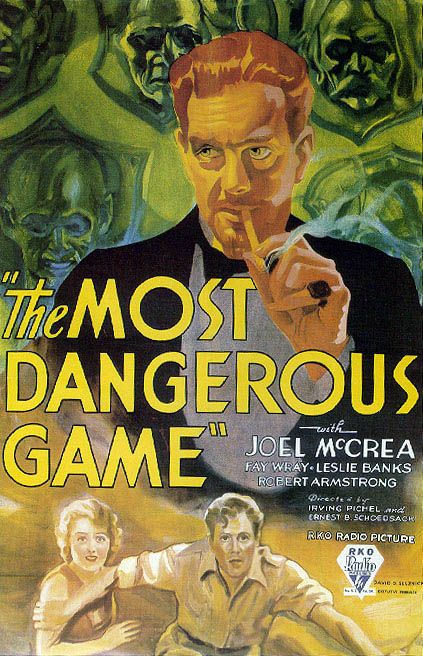
"The Most Dangerous Game"
Richard Connell (1924)

"Life is for the strong, to be lived by the strong, and, if needs be, taken by the strong. The weak of the world were put here to give the strong pleasure. I am strong. Why should I not use my gift? If I wish to hunt, why should I not? I hunt the scum of the earth: sailors from tramp ships -- lassars, blacks, Chinese, whites, mongrels - a thoroughbred horse or hound is worth more than a score of them."


The intensity of this story wasn’t completely real to me at first; the words on this page were horrifying, but what they truly entailed wasn’t honed in and honest until I read it in it’s entirely for a second time. For it’s time, “The Most Dangerous Game” was a story that stood out, such subject matter wasn’t really written about, I’d assume. But this story has some very similar traits to more modern novels and movies – in a way, it’s been an increasing trend.

So Connell’s story fits right in.

I found it interesting how cultures and people were spoken of in this story; Zaroff speaks of African Americans, Chinese, and anyone who isn’t white, as if they’re animals. Even lesser than ‘lesser beings’. He speaks of Ivan, his aid, in terrible light, even though he’s exceedingly important for the General’s survival on the island. Also, the level-headed manner in which Zaroff treats Rainsford; even when one is hunting the other, Zaroff speaks to Rainsford in a very proper way. His manners are in tact for the entirety of their interactions, even at the very end.

In a way, the general reminded me very much of Hannibal Lecter; formal, polite, a stickler for detail. And, well, they’re both cannibalistic murders. So that’s definitely a bit of a similarity.

Also, or perhaps more importantly, the words spoken by Zaroff about power; he has plenty of it, and he sees no reason why he shouldn’t use it. I think this story is based very much in power, and is a lesson to the readers as to how one should use it. In the case of Zaroff, he abuses his power in awful ways. He murders men because the sport of hunting animals because too mundane for him. And with his wealth and influence, has justified murdering dozens of humans just to satiate his need for power.

In contrast, we have Rainsford; he is also a hunter, and has even published books about his achievements and skills in the field. He has an abundance of power, but even when he could use it for evil, he does not. Of course, while he’s being hunted, he uses his skills against the general, but for the means of defense. Everyone has a will to live, and Rainsford used his power and skill to survive. As a whole, he did not abuse his power, while Zaroff did.

I took away a warning from this story – one being that power can destroy you. It can twist you until you aren’t human, you’re a mutation of a human. Your morality is lost in a search for it, and in the end it destroys you.


Also, don’t kill people and indulge in cannibalism. That’s not the wisest life choice.

Tuesday, September 23, 2014

Entry Eight: Bierce

"An Occurrence at Owl Creek Ridge"
Ambrose Bierce (1890)

"His neck was in pain and lifting his hand to it found it horribly swollen. He knew that it had a circle of black where the rope had bruised it. His eyes felt congested; he could no longer close them. His tongue was swollen with thirst; he relieved its fever by thrusting it forward from between his teeth
into the cold air. How softly the turf had carpeted the untraveled avenue -- he could no longer feel the roadway beneath his feet!"


This is another story we’ve read that’s knocked the wind out of my by the end; there’s so much about it that I appreciate about this short story. The style, the tone, and most importantly the paradigm shift at the end, which took my by surprise almost immediately. Perhaps I was just hopeful Peyton had survived, but I still can’t stop thinking about this ending.

To begin, I’d like to mention the flow of this story, the seamlessness that aids to the suspension of disbelief. From reading the first sentence to the last one, I didn’t catch on any immediate change of setting or thought process. Peyton’s fight to live was strong throughout the entire narrative, and not once did I honestly question it. I found myself wanting the main character to live, even though every aspect of his situation wouldn’t allow it. I was rooting for the underdog because I wanted nothing more than his freedom.

Which then leads me to the most important and complicated point I’d like to really think out, which is Peyton’s death. For practically four pages of the story, our main character is dead in his current timeline. But we’re brought about on this journey with him; we fall into the river, free our bound hands, we swim and dodge bullets until we flee into the forest. Throughout his struggle, his fight, I believe that it’s all symbolic of what he goes through before he passes.

The pain anyone goes through while being hung must be excrutiating, and I can only imagine that the imagination-driven journey we’re brought on is Peyton’s mind. His thoughts are distancing himself from the intolerable pain that’s been inflicted upon him.

This kind of story has been told and retold – someone creates a fantasy because the real world was too much to handle. Specifically, I think of the Doctor Who episode Asylum of the Daleks. Clara has manifested her entire mind to believing she’s shipwrecked, when in reality she’s been modified into a dalek all along.  She even drew others into her fantasy, because the horror of what had happened to her was too great to bear.


For Peyton, the reality of losing his life with his wife and children was too much to handle; instead, his mind let him imagine he’d gotten away. The quote above, to me, is the proof of this; physical symptoms of being hung are showing in his fantasy, right before he goes and “sees” his wife. It’s the last sign of his humanity, before he passes on to see his family.

Wednesday, September 17, 2014

Entry Seven: Matheny

God of Love
Luke Matheny (2010)

"You can't control who you love. You can't control who loves you. You can't control how it happens or when it happens or why it happens. You can't control any of that stuff."


Love is, to many extents and in many facets, is the most complicated thing that anyone will encounter in their lives. It’s more frustrating than calculus, as well as more frequently experienced in daily life. Of course, it holds an excessive amount of value in our society’s social structure, both emotionally and in a way, financially; it’s more fiscally useful to be married than to not be. And what is the most “important” thing a marriage is based on? Love.

In the case of this film, love is something that Raymond can’t quite get a grasp of, as least not in the way he wanted it. He’s fallen for the drummer of the band he sings for, Kelly, who has none of those romantic feelings for him whatsoever. With this issue in mind, Ray turned to God; he prayed daily for the requited love of Kelly, in fact that is the only thing he prays for. Yet, it’s never acted upon by God, at least, not in the way that Ray desired.

What I found intriguing throughout this short film is the development of Raymond; it’s exceedingly slow, in a way that I was almost positive  he wasn’t going to change at all. In the last scene, I was very sure in the thought that he was going to throw his dart at Kelly, thrusting the two in love for another six hours. The sudden realization that he’s going to help his best friend and his life long crush fall in love was the most intense character shift that could’ve happen for him.

It’s even more heartbreaking when you remember that Fozzie told Ray that their friendship mattered more than the relationship he and Kelly could’ve had. Fozzie did everything for Ray’s six hours with Kelly – he made dinner, set up the room, and dressed in a ridiculous costume to make the night complete.

And in the end, it’s Ray that seals the deal. He’s watching out for his friend, and does the right thing. The noble and most kind thing he can do.


In the end, what just got to me was that Ray ends up making other people happy after the gift granted to him in the beginning doesn’t get him the love of his life. It was probably supposed to be that way, and with good reason, but the disappointment he must’ve felt didn’t make his realization any easier. But Ray takes it in stride, scootering off into the sunset with a bow and quiver over his shoulder.

Monday, September 15, 2014

Entry Six: Atwood

Happy Endings
Margaret Atwood (1983)

“You’ll have to face it, the endings are the same however you slice it. Don’t be deluded by any other endings, they’re all fake, either deliberately fake, with malicious intent to deceive, or just motivated by excessive optimism if not by downright sentimentality. The only authentic ending is the one provided here: John and Mary die. John and Mary die. John and Mary die.”


I know nothing of Margaret Atwood, other than the fact she and Douglas Adams should get coffee, because their writings seem very similar to me. Perhaps it’s my dry sense of humor, and works by both of the aforementioned authors seem to utilize that same use of sarcasm that I’ve come to admire. Also, they’re both very intelligent, and give a very new perspective on the daily things that appear in peoples lives (if you count hitchhiking on Vogon ships with a bath towel a daily event, that is).

In the case of Happy Endings, it’s a very dry and straightforward story. It depicts John and Mary as the American Dream couple – they fall in love, get married, have children, own a home, and die happy. This, of course, is far from a realistic expectation for anyone’s life, because life is never that simple.

Which is why extensions B, C, D, E, and F come into play.

With each addition, the story is warped; Mary and John don’t fall in love completely, and John turns out to be using her for sex and nothing more. Or one is older than the other, and one is pining over someone else. It adds a very stark contrast in content for these stories; you start off with a dream family, and slowly add layers upon layers of reality, which seem to make the outcome of marriage not as important or as realistic a goal as it once was.

Something I really like about this story is the fact everything said is cold, hard fact; there are people who are going through relationships just like this everywhere and every day. There are office women who fall for bad boys and businessmen who sleep around because their marriage isn’t satisfying anymore. When Atwood says that plots “are just one thing after another”, alluding to the fact that life is really just one thing after another thing. Perhaps they aren’t entirely worth changing or challenging, because in the end more things are going to happen after this one bad thing to begin with.

In addition, the distanced and almost dismissive attitude in which these character’s stories are told is intriguing to me. Atwood shows almost no emotional connection to these characters; their story is nothing much more than a news report. That kind of emotional distancing is very common in our modern day and age, and maybe it’s a reason why so many relationships end in ways that the author depicts.


And, in the end, we all do just die anyway. So maybe we shouldn’t care as much.