Hisaye Yamamoto (1988)
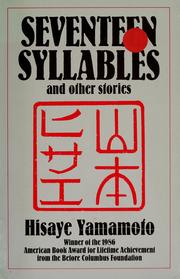 "It was like a story out of the magazines illustrated in sepia, which she had consumed so greedily for a period until the information had somehow reached her that those wretchedly unhappy
 autobiographies, offered to her as the testimonials of living men and women, were largely inventions: her mother, at nineteen, had come to America and married her father as an alternative to suicide."
Unlike the majority of the stories we’ve read, this one took
a much longer time to get used to and understand – I can’t decide if it’s how
it’s written, or how the majority of the plot seems to happen in the last half
of the story. There was a certain amount of time where I really wasn’t
interested in the story at all, and it wasn’t until the last half or so that I
was even interested. That being said, I saw a lot of this story as a coming of
age story. It’s how Rosie was, in many respects, forced into adult life and
adult problems within the span of these pages.
Something that caught my attention especially was the
mindset of our third person narrator, Rosie. There was a part of her that was
very young, but still mature for her age; after all, she’s working on her
father’s tomato farm, so she has a certain amount of responsibility. But at the
same time, there are moments where I feel like her expectations aren’t always
in line with the maturity she displays. The biggest example of this is with her
father; her relationship is strained with him as it is, so her openness and
hope for something genuine is wonderful, but at the same time, lining her up
for disappointment ever time.
Perhaps, the thing that stuck out to me the most was the
consistent theme of time – there’s mention of deadlines for her mothers
haiku’s, her fathers farm, her meeting with Jesus. There’s always something
waiting to happen, something scheduled that looms overhead. This seems most
evident when her mother admits her past to Rosie at the very end of the story –
something so sensitive and personal was held off until the very last moment. In
this case, time was misused, leading to an admission at probably one of the worst
times.
It is, though, a reminder at how fragile our time is – how one
day, everything you know can change.

No comments:
Post a Comment